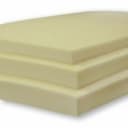
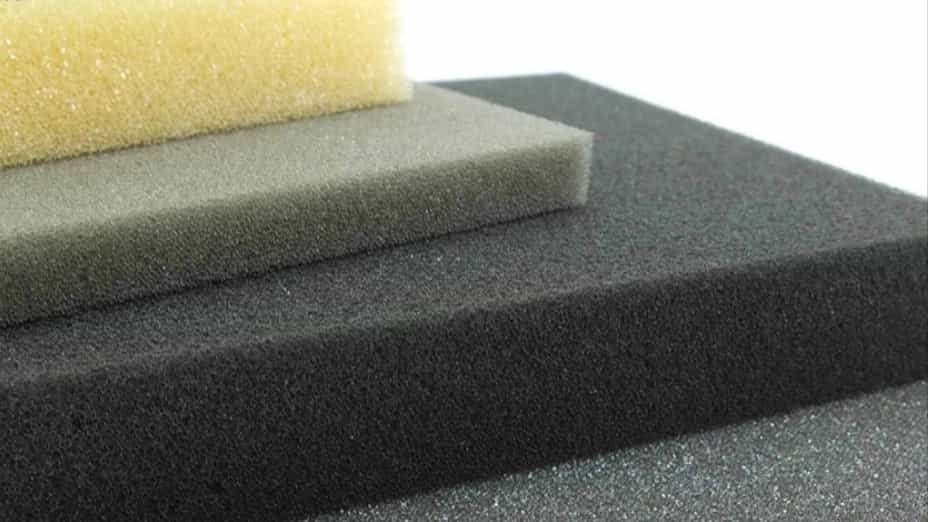
In general, types of polyurethane foam are divided into 3 main groups and include soft, semi-soft and hard foams.
ان Soft foam 🔶
Those foams that have eight open soles and their density is approximately 93 x 3 inches are known as soft polyurethane foam. Because these types of foams have open cells, air easily passes through them, and also because of their physical and mechanical properties, they show greater tensile strength and length. Soft foams are very resistant to most solvents due to their high sound absorption properties and low thermal conductivity.
These foams change color quickly if exposed to sunlight. Also, if these types of foams are exposed to strong acids and bases, they will no longer have enough endurance and durability, and this is due to the properties of this type of foams.
ار Semi -hard foams
Semi-rigid foams are similar to soft foams, and when there is a change in their formulation, significant effects on hardness and other properties are created. Among their advantages, it can be said that they absorb water easily, but they do not absorb air humidity.
ار Hard polyurethane foams
Rigid polyurethane foam is a type of foam that has been used in the construction of prefabricated materials such as sandwich panels since 1940. In 1960, the consumption of rigid polyurethane foams increased due to two factors, which we will mention below.
The use of monofluometry, which is used as a factor for puffing.
MDI, a polymer that has simplified the process due to its properties. There are fewer foams and this is one of the advantages that has led to the use of hard polyurethane foam for insulation.
💠 Specifications of each type of polyurethane foam
⬇️ Features of soft polyurethane foam ⬇️
Soft polyurethane foam has high flexibility and tensile strength due to its structure with open cells and air flow in these cells, and therefore it is used in the production of all kinds of furniture, mattresses and car seats. Soft polyurethane foams quickly lose their color when exposed to UV rays. Also, these foams have weak resistance against strong acids and bases.
⬇️ Features of semi-soft polyurethane foam ⬇️
Semi-soft foams can be made from the appropriate combination of polyester and isocyanates. By changing the formulation of these materials, it is possible to change the properties of this type of foam.
⬇️ Characteristics of hard polyurethane foam ⬇️
Hard polyurethane foam has a closed cell structure and a low thermal conductivity coefficient compared to other foams and is used as insulation in sandwich-like structures. The thickness of polyurethane foam used (S) in sandwich panel production is dependent on the temperature difference between inside and outside, temperature transfer rate (Q) and thermal conductivity coefficient.